


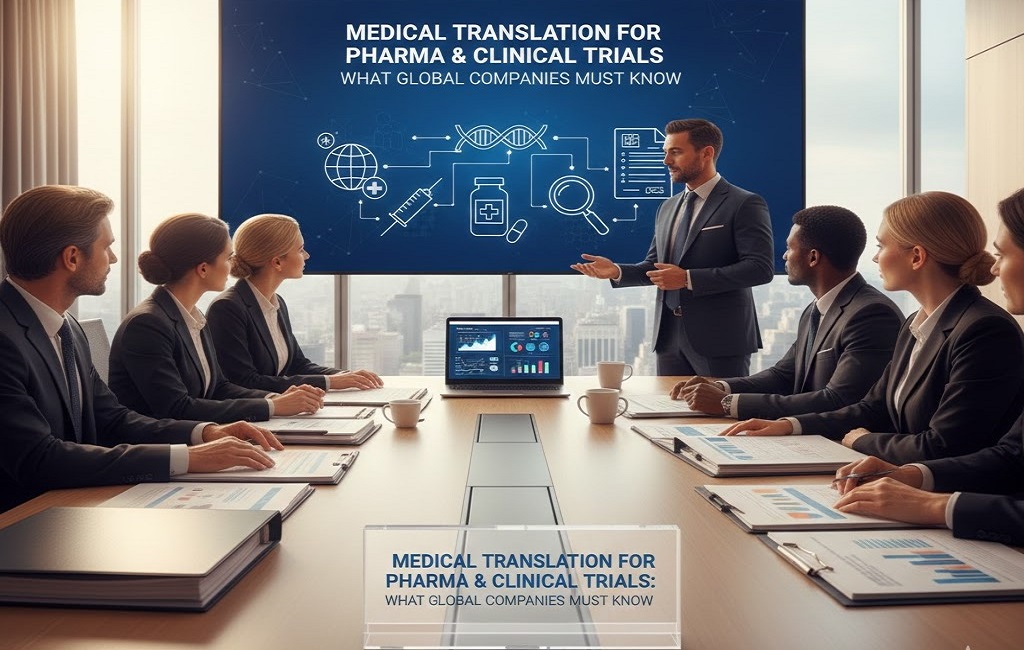
Medical translation services are not about language -they are about compliance, risk, and patient safety.
Pharma companies, CROs, and medical device manufacturers operate across multiple countries, regulators, and languages. Every clinical trial document, regulatory submission, and patient-facing material must be accurate, consistent, and legally defensible.
A single translation error can delay approvals, invalidate trial data, or trigger regulatory action. This is why medical translation for pharma and clinical trials requires specialized expertise, not generic translation.
This guide explains what companies in India, the USA, and global markets must know before outsourcing medical translation services.
Pharmaceutical translation directly affects:
- Regulatory approvals
- Patient safety
- Clinical trial integrity
- Audit and inspection outcomes
- Legal and compliance risk
Regulatory authorities such as the FDA (USA), EMA (Europe), CDSCO (India), and PMDA (Japan) expect translated medical documents to be scientifically accurate, traceable, and terminology-consistent.
In regulated environments, translation errors are treated as process failures, not minor language issues.
Clinical Trial Translation
- Clinical Trial Protocols (CTP)
- Investigator’s Brochure (IB)
- Informed Consent Forms (ICF)
- Case Report Forms (CRF)
- Patient Information & recruitment materials
Regulatory & Compliance Translation
- Regulatory submissions and dossiers
- Safety reports (CIOMS, SUSARs)
- Pharmacovigilance documentation
- Risk Management Plans (RMP)
Medical & Scientific Content
- Clinical Study Reports (CSR)
- Medical device IFUs
- Labeling, SmPCs, and PILs
- Scientific publications
Each document type carries different risk levels, which must be reflected in the translation workflow.
1. Using Generic Translation Vendors
Many providers claim “medical expertise” but rely on generalist translators, leading to terminology errors and regulatory rework.
2. Over-Reliance on Raw Machine Translation
MT and MTPE can support workflows, but raw or poorly post-edited MT in clinical or patient-facing content is a serious compliance risk.
3. No Terminology Governance
Without validated glossaries:
- Drug names change
- Adverse event terms drift
- Cross-language consistency breaks
This is a major audit red flag.
MTPE can work for:
- Large-volume, low-risk internal content
- Non-patient-facing documents
- Reference or review material
Human translation is essential for:
- Informed Consent Forms
- Regulatory submissions
- Patient-facing documentation
- Pharmacovigilance and safety reports
A professional medical translation provider will clearly define where MTPE is acceptable -and where it is not.
Your partner should offer:
- Domain-specialized medical linguists with life sciences experience
- Structured QA workflows (translation, review, validation, final QA)
- Regulatory awareness aligned with FDA, EMA, and global standards
Medical translation must function as part of your quality management system, not as a standalone task.
India has become a trusted hub for medical and pharmaceutical translation services due to:
- Strong English-centric medical expertise
- Large pool of trained life sciences professionals
- Scalable multi-language delivery
- Cost efficiency without quality compromise
- Proven experience with US and EU pharma clients
When done with the right partner, outsourcing to India delivers speed, scale, and compliance.
Medical translation is not one-size-fits-all.
Documents prepared for:
- US FDA submissions
- EU regulatory review
- Indian clinical trial approvals
require localization based on regulatory language, patient comprehension, and regional terminology. Global consistency must be balanced with local compliance.
Conclusion: Expertise Over Convenience
Medical and clinical translation is a strategic, risk-sensitive function. Speed and cost matter -but accuracy, consistency, and accountability matter more.
Global pharma companies must partner with providers who understand medical science, regulatory expectations, and quality-driven workflows.
Looking for medical translation services for pharma or clinical trials in India, the USA, or global markets?
Contact TranslationInIndia.com for compliant, scalable, and professional pharmaceutical translation services.